

Has your dentist told you that you don’t have enough bone at the back of your upper jaw and that traditional implants aren’t possible without a graft? Or have you heard about pterygoid implants and want to understand what they are before making any decisions?
You’re in the right place. In this guide we explain clearly what pterygoid implants are, how they work, when they’re indicated and how they differ from other advanced solutions such as zygomatic implants – without unnecessary jargon.
What are pterygoid dental implants?
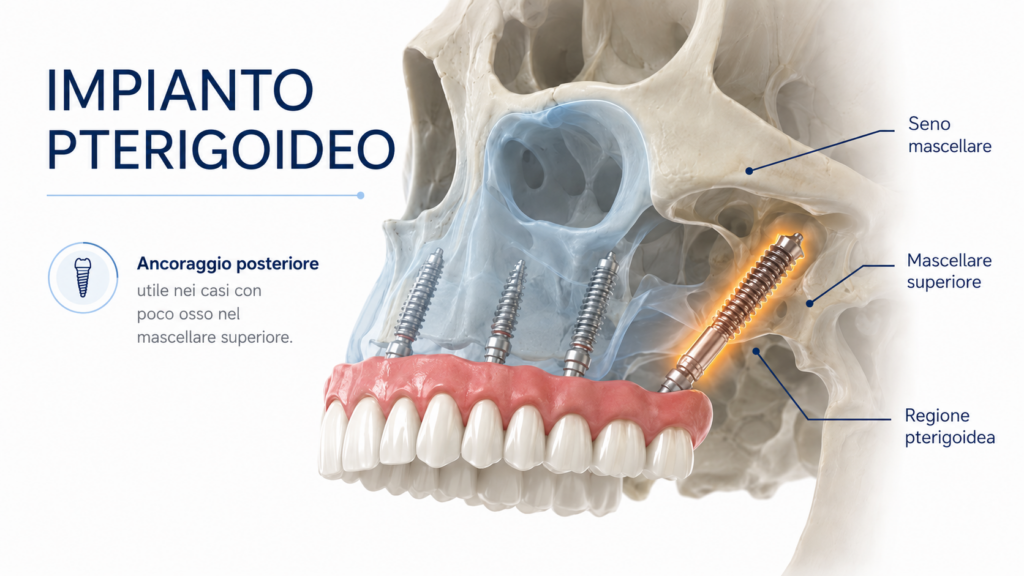
Pterygoid implants are dental implants that are longer than standard ones, designed to be anchored in the pterygoid plates – a dense, highly mineralised bone structure located at the back of the skull, behind the upper jaw.
The name comes from this structure: “pterygoid” derives from the Greek pteryx (wing), referring to the shape of the pterygoid processes of the sphenoid bone, in which these implants are anchored.
Unlike traditional implants – which rely on the alveolar bone of the upper jaw, the first to resorb after teeth are lost – pterygoid implants reach bone that stays intact even with advanced upper jaw atrophy. This makes them an effective option for people who don’t have enough bone in the upper back molar area.
In simple terms: imagine the jawbone as a layer of soil that has eroded over time. Pterygoid implants “dig deeper”, reaching a layer of solid rock – the pterygoid plates – on which they can rest securely.
When are pterygoid implants indicated?
Pterygoid implants are an advanced implant solution indicated in specific situations. They aren’t suitable for every patient, but in certain cases they can be the most effective choice – and less invasive than the alternatives.
Main indication
Posterior bone atrophy
When the bone in the upper molar area is insufficient for standard implants and a sinus lift isn’t feasible or isn’t what the patient wants.
Secondary indication
Pneumatised maxillary sinus
When the maxillary sinus has expanded a great deal and occupies much of the available bone space, making a sinus lift technically complex or risky.
Additional indication
Full-arch rehabilitation
In combination with other implants (including zygomatic ones) to restore the entire upper arch in patients with severe bone atrophy, reducing or eliminating the need for bone grafts.
Who can benefit
- Patients who lost upper back teeth years ago, with resulting bone atrophy
- Patients who have already had an assessment and been told “you don’t have enough bone”
- Patients who want to avoid a sinus lift
- Patients who need fixed teeth within a reasonable time frame
How the procedure works: the main stages
Placing pterygoid implants is an advanced implant procedure that requires specific surgical experience and careful planning. Here is how it works, in brief.
1
Diagnosis and planning with a 3D CT scan
Before surgery a cone beam CT scan (CBCT) is taken to analyse precisely the bone structure, the path of the implant and its relationship with nearby anatomical structures. Digital planning is essential for safety and precision.
2
Surgery under local anaesthesia (or sedation)
The implant is placed under local anaesthesia. Patients with significant anxiety can opt for conscious sedation. The implant is guided through the maxillary tuberosity to the pterygoid plates, following the digitally planned path.
3
Immediate or delayed loading
In many cases immediate loading is possible: a temporary prosthesis is fitted at the same appointment or shortly afterwards. The final prosthesis is placed once osseointegration is complete, usually within 3–6 months.
4
Check-ups and follow-up
In the following months, check-ups are scheduled to monitor osseointegration and the health of the tissues around the implant. Good hygiene and regular check-ups are essential for the implant’s longevity.
Pterygoid vs zygomatic implants: what’s the difference?
Patients often hear about both solutions and wonder what the difference is. They are two distinct techniques, indicated for different situations, but sometimes used together in the same rehabilitation.
| Pterygoid implants | Zygomatic implants | |
|---|---|---|
| Anchorage | Pterygoid plates (sphenoid bone) | Zygomatic bone (cheekbone) |
| Area treated | Back of the upper jaw | Side/front of the upper jaw |
| Implant length | Longer than standard, but shorter than zygomatic implants | Very long (30–52 mm) |
| Typical indication | Bone atrophy in the back molar area | Severe bone atrophy of the entire upper jaw |
| Invasiveness | Lower | Higher |
| Often used together? | Yes – they can be combined in complex full-arch rehabilitation | |
Find out more about zygomatic implants: read the dedicated article
Advantages of pterygoid implants compared with a sinus lift
For many patients, the main alternative to pterygoid implants at the back of the mouth is a sinus lift followed by standard implants. Here is how the two compare.
Pterygoid implants
- No bone graft needed
- Shorter treatment times
- A single surgical procedure
- Immediate loading often possible, in suitable cases
- Less invasive overall
- Very dense, stable anchoring bone
Sinus lift + standard implants
- Requires a preliminary bone graft
- Longer treatment (4–9 months’ wait)
- Two separate surgical stages
- Immediate loading not always possible
- More invasive in the first stage
- Standard implants once the bone has regenerated
No single option is right for everyone. The choice between pterygoid implants and a sinus lift depends on the patient’s anatomy, the extent of atrophy, general health and personal preferences. Only a careful clinical assessment – with a 3D CT scan – can show which approach is most suitable in your case.
Frequently asked questions about pterygoid implants
They are dental implants longer than standard ones, anchored in the pterygoid plates – a dense bone structure at the back of the skull, behind the upper jaw. They allow implants to be placed in the back molar area even when there isn’t enough jawbone.
They are mainly indicated when the bone in the upper back molar area is insufficient for standard implants and the aim is to avoid a sinus lift. They are also used in complex full-arch rehabilitation, often in combination with zygomatic implants.
The procedure is carried out under local anaesthesia, so you shouldn’t feel pain during it. Afterwards, some swelling and discomfort in the first few days is normal and can be managed with the prescribed medication. Compared with a sinus lift, it is generally less invasive overall.
Pterygoid implants are anchored in the pterygoid plates and treat the back of the upper jaw. Zygomatic implants are anchored in the zygomatic bone (cheekbone) and are indicated for more extensive atrophy of the whole upper jaw. In some cases they are used together in the same rehabilitation.
In most cases, yes: because they are anchored in a different bone structure from the alveolar jawbone, they bypass the maxillary sinus, removing the need for a preliminary bone graft in that area.
Like all dental implants, if placed correctly and maintained with good hygiene and regular check-ups, they can last for decades. Longevity depends on the quality of osseointegration, the patient’s general health and ongoing care.
The cost varies according to the complexity of the case, the number of implants needed and the type of prosthesis planned. It is an advanced technique requiring specific surgical experience, so the cost is generally higher than for standard implants. A personalised assessment is the first step to receiving a clear, transparent quote.
The cost varies according to the complexity of the case, the number of implants needed and the type of prosthesis planned. It is an advanced technique requiring specific surgical experience, so the cost is generally higher than for standard implants. A personalised assessment is the first step to receiving a clear, transparent quote.
No. It is an advanced implant technique requiring specific training, solid surgical experience and appropriate equipment – including digital planning with a 3D CT scan. It’s important to choose a clinician with proven experience in complex implantology.
Please note: this content is for information only and does not replace an individual clinical assessment. Every case must be assessed by a clinician experienced in advanced implantology.
Been told you can’t have implants because of a lack of bone? We can assess your case in Modena.
At Tommaso Grandi Dental Clinic we place pterygoid implants and offer other advanced solutions for patients with bone atrophy. Using 3D cone beam CT and digital planning, we analyse your situation and explain clearly what your options are.
Book an implant consultation and find out whether pterygoid implants are the right solution for you.