

Have you just had a dental implant – or are you thinking about one – and wondering what happens after surgery? The term you’ll hear most often is osseointegration: the biological process that determines whether an implant succeeds or fails over time.
In this guide you’ll find a clear explanation of what osseointegration means, how long it takes, which signs show it is progressing well and – above all – what you can do to support it after surgery.
What does osseointegration mean?
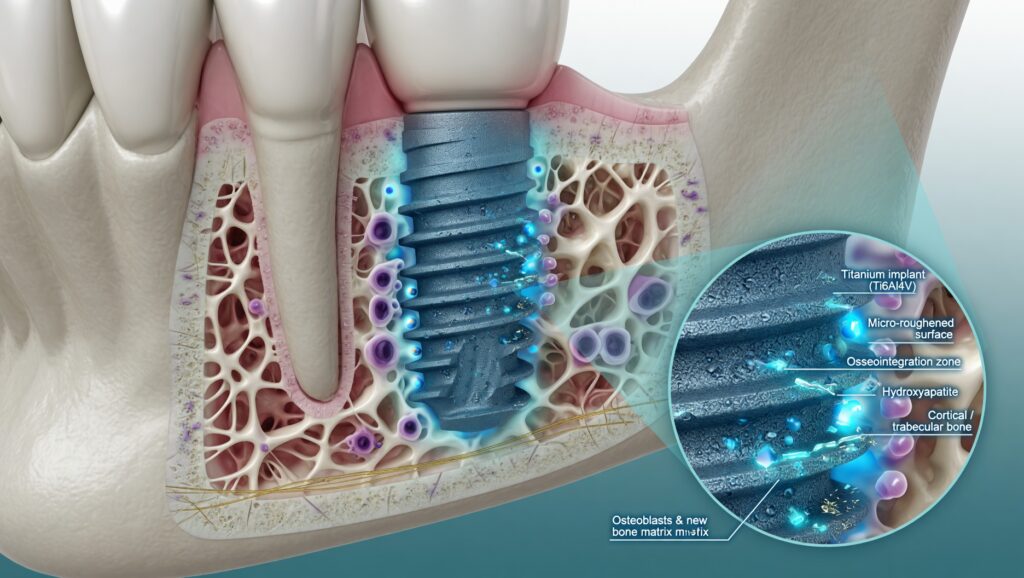
Osseointegration is the process by which the jawbone bonds directly with the surface of a titanium dental implant, creating a stable, lasting connection with no fibrous tissue in between.
The concept was introduced in the 1960s by the Swedish surgeon Per-Ingvar Brånemark, who first observed how titanium – unlike other materials – was “accepted” by bone at cellular level, becoming an integral part of the skeletal structure.
In practice, the implant isn’t simply “held in place” by the bone, like a nail in a wall. Bone cells literally grow around the implant surface, enveloping it and integrating with it. This is what makes titanium implants so stable and long-lasting.
In simple terms: think of osseointegration as the implant “taking hold” in the bone. Without it, the implant has no solid base and can’t support the crown. With good osseointegration, an implant can last for decades.
How long does osseointegration take?
Timing varies from patient to patient and depends on several factors. Generally speaking, the process is considered complete within about 6 to 16 weeks – but there are some important distinctions to know.
First few days – days 0 to 7
Clot formation and inflammatory response
Immediately after the implant is placed, the body starts a normal inflammatory response. A clot forms around the implant: this is the starting point of healing. Swelling and discomfort at this stage are normal.
Early phase – weeks 1 to 4
Formation of primary bone
Bone cells (osteoblasts) start to deposit around the implant surface. A first layer of “immature” bone forms and begins to stabilise the implant. Discomfort gradually decreases.
Middle phase – weeks 4 to 12
Bone maturation
The immature bone is gradually replaced by mature, mineralised bone. The implant becomes increasingly stable. This is the most delicate phase: the right behaviour during this period makes a difference.
Final phase – 3 to 6 months
Complete osseointegration
The bone has fully matured around the implant. The clinician checks stability and, if osseointegration has taken place correctly, goes ahead with fitting the final crown.
What affects the timing?
Factor 1
Bone quality
Dense, well-vascularised bone supports faster healing. The lower jaw tends to osseointegrate more quickly than the upper jaw, which is generally more spongy.
Factor 2
General health
Uncontrolled diabetes, osteoporosis, bisphosphonate treatment and smoking slow down or compromise osseointegration. It’s essential to share your full medical history with your clinician.
Factor 3
Post-operative behaviour
Careful hygiene, a suitable diet, avoiding smoking and following your dentist’s instructions are the factors you can directly influence to support good healing.
What are the signs of osseointegration?
Let’s distinguish between signs that osseointegration is going well and those that suggest a problem not to be ignored.
✅ Positive signs
- Mild swelling and discomfort in the first 3–5 days, gradually decreasing
- A small bruise in the treated area that clears up on its own
- Tenderness to touch around the implant in the first few weeks
- No pain at rest after the first week
- A stable implant that doesn’t move at check-ups
⚠️ Signs not to ignore
- Pain that persists or worsens after the first few days
- Swelling that doesn’t go down or gets worse after the first week
- Implant movement you can feel with your tongue or fingers
- Pus or a persistent bad taste
- A temperature above 38°C in the hours after surgery
When should you contact your dentist straight away?
- Sharp pain that doesn’t respond to the prescribed painkillers
- An implant that moves, even slightly
- Swelling or pus after the first 5–7 days
- A feeling that something “isn’t right” – trust your instinct and call
How to support osseointegration
Your clinician’s work is essential, but the post-operative period is largely in your hands. Here’s what you can do in practice to support healing.
Diet
✅ What to eat
- Soft foods in the first few weeks: yoghurt, eggs, fish, cooked vegetables
- Foods rich in calcium and vitamin D (helpful for bone mineralisation)
- Enough protein to support tissue regeneration
- Plenty of water to aid healing
❌ What to avoid
- Hard, crunchy foods or those that need a lot of chewing
- Very hot foods in the first day or two
- Alcohol, which slows healing and interacts with medication
- Chewing on the implant side before your dentist says you can
Oral hygiene
Good hygiene is essential to avoid infections that could compromise osseointegration. Follow your dentist’s instructions, which usually include:
- Gentle brushing with a soft toothbrush, avoiding the implant area for the first day or two
- Rinsing with chlorhexidine mouthwash as directed by your clinician
- Using interdental brushes or floss around the implant as soon as your dentist allows
- Avoiding vigorous rinsing in the first few hours after surgery
Lifestyle
✅ Habits that support osseointegration
- Stop smoking: smoking reduces blood supply to the bone and significantly increases the risk of implant failure
- Rest: avoid strenuous physical activity for the first day or two
- Sleep with your head slightly raised for the first few days to reduce swelling
- Attend your scheduled check-ups: they’re the most reliable way to make sure everything is progressing well
- Take the prescribed medication: complete courses of antibiotics and painkillers even if you feel better sooner
💡 The most underestimated factor: smoking is the main enemy of osseointegration. Smokers have a significantly higher implant failure rate than non-smokers. If you’re considering an implant, now is an ideal time to stop – or at least cut down considerably.
Please note: this content is for information only and does not replace an individual clinical assessment. If you have any doubts about your own case, always consult your clinician.
Frequently asked questions about osseointegration
Osseointegration is the biological process by which the jawbone grows directly around the surface of a titanium implant, integrating with it with no fibrous tissue in between. It is the mechanism that makes dental implants stable and long-lasting.
On average between 6 and 16 weeks, varying according to bone quality, implant site and the patient’s general health. The lower jaw tends to integrate more quickly than the upper jaw. Your clinician checks the implant’s stability before fitting the final prosthesis.
Positive signs are: swelling and discomfort gradually easing after the first few days, no pain at rest after the first week and a stable implant at check-ups. Persistent pain, implant movement or increasing swelling should be reported to your dentist straight away.
In the first hours and days it’s normal to feel discomfort, swelling and tenderness in the treated area. These symptoms gradually ease. Sharp or increasing pain after the first few days is not normal and should be reported to your dentist.
Good oral hygiene, a balanced diet rich in calcium and vitamin D, not smoking, following post-operative instructions and attending scheduled check-ups are the main factors the patient can influence. Smoking is the most significant risk factor for failed osseointegration.
Yes, significantly. Smoking reduces blood supply to the bone, slows healing and increases the risk of peri-implantitis – an inflammation that can lead to implant failure. Implant outcomes in smokers are poorer than in non-smokers.
If the implant doesn’t integrate properly, it becomes loose and must be removed. After an appropriate healing period, in most cases the implant can be placed again, once the causes of the previous failure have been addressed.
In the first few weeks it’s advisable to choose soft foods and avoid putting too much load on the implant area. As integration progresses, your dentist will tell you when you can return to normal chewing.
Have you had an implant or are you considering one? We’re in Modena.
At Tommaso Grandi Dental Clinic we follow each patient through every stage of implant treatment – from surgery to checking osseointegration, through to the final prosthesis. We explain what to expect at each stage and how to manage your recovery.
Book an implant consultation and find out which treatment plan suits your situation.