

When people talk about advanced implantology, especially in cases of severe bone loss, it’s easy to come across the names of many different techniques: full-arch rehabilitation on four or six implants, zygomatic implants, pterygoid implants, graftless techniques, bone regeneration.
So which technique is the right one?
In genuinely complex cases, the answer is that no single technique is right for everyone.
There is the most suitable solution for that specific person at that particular moment, based on their anatomy, the quantity and quality of available bone, their general health and the goals of treatment.
And this is exactly what changes the meaning of implantology in complex cases: the point is not to apply the same procedure every time, but to be able to assess several options and choose the most appropriate one.
When is an implant case considered complex?
Lack of bone is certainly one of the most familiar factors, but it isn’t the only one.
A case can become complex when there is:
- significant resorption of the upper or lower jawbone;
- previously failed implants;
- removable dentures worn for many years;
- severely compromised teeth that need extracting;
- poor quality of the remaining bone;
- proximity to delicate anatomical structures;
- major changes in the shape of the upper jaw;
- a need to restore an entire arch;
- particularly complex functional and aesthetic needs.
That’s why talking generically about implants with little bone can be an oversimplification.
Two patients who have both been told they have “too little bone” could have completely different situations and need equally different treatment strategies.
Little bone doesn’t necessarily mean implants are impossible
One of the most common mistakes is to consider only the amount of bone available.
In reality, implant planning looks at many parameters: where the remaining bone is, its density and angle, the anatomy of the upper jaw, and its relationship with the maxillary sinuses, nasal cavities and other anatomical structures.
How the bone is distributed can also be decisive.
So a diagnosis of severe bone atrophy does not automatically mean that implant treatment is impossible.
Rather, it means the case needs to be studied with the right diagnostic tools, by a clinician with experience in the different options offered by advanced implantology.
The role of the CT scan in implant planning
In complex cases, the cone beam CT scan – usually called CBCT – is one of the key diagnostic tools.
It provides a three-dimensional reconstruction of the anatomy and allows a more precise assessment of:
- the quantity and distribution of bone;
- the shape of the upper jaw;
- the position of the maxillary sinuses;
- the nasal cavities;
- the path of nerves and other anatomical structures;
- any implants already present.
So the CT scan isn’t just about checking whether there is “enough bone”.
It’s about understanding where the usable bone is and which surgical strategy could be considered.
Diagnosis comes before technique.
Full-arch treatment on four or six implants: what does it really mean?
Full-arch protocols on four or six implants are terms used for complete restorations of an arch supported by four or six implants respectively.
They are very well-known protocols, but they are not a universal answer.
The number, position and angle of the implants should depend on the patient’s anatomy and on the prosthetic plan.
In some cases four implants may be enough.
In others it may be advisable to use six.
In others still, the remaining bone may not allow a traditional implant configuration.
The risk arises when the name of the technique is treated as more important than the diagnosis.
An implant plan should start from the patient’s clinical situation, not from the need to fit every patient into a pre-set protocol.
Zygomatic implants in severe upper jaw atrophy
Zygomatic implants are one of the solutions used in advanced implantology for some patients with severe bone loss in the upper jaw.
Unlike conventional implants, they are anchored in the cheekbone (zygomatic bone).
They may be considered in selected situations where the remaining upper jawbone doesn’t allow conventional treatment, or when an alternative to more extensive regenerative procedures is being considered.
However, this is highly specialised surgery.
Whether it is appropriate must be decided after a careful study of the anatomy and the overall treatment plan.
Having little bone does not, on its own, automatically mean you need zygomatic implants.
Pterygoid implants: using the bone available at the back of the jaw
Pterygoid implants are another option in advanced implantology.
They are placed in the back of the upper jaw and, in certain cases, make use of anatomical areas where more bone is available.
They can help provide implant support at the back of the mouth even when the upper jaw has undergone significant resorption.
Again, this is not a solution to be applied routinely.
Zygomatic, pterygoid, conventional implants or other configurations can be used on their own or, in selected cases, combined.
It is the diagnosis that determines which configuration makes sense.
What does graftless implantology mean?
“Graftless” refers to various implant strategies that, when clinical conditions allow, aim to make use of the remaining bone, avoiding or reducing the need for major bone grafts.
This approach can involve different types of implant and different surgical techniques.
The core idea is simple: rather than necessarily rebuilding bone where it has been lost, in some cases treatment can be planned using other anatomical areas that are still available.
This doesn’t mean bone grafts are wrong.
It means that today, in implantology for complex cases, there may be more than one option.
Once again, the choice depends on the anatomy, the goals of treatment and the patient’s condition.
Immediate loading: when can you have fixed teeth?
Another concept often associated with advanced implantology is immediate loading.
Under certain conditions, a fixed temporary prosthesis can be fitted on the implants in the hours or days after surgery.
However, immediate loading cannot be promised to every patient.
It requires suitable clinical and biomechanical conditions, including sufficient implant stability and correct distribution of forces.
Whether immediate loading is possible must therefore be checked during planning and confirmed on the basis of what is found clinically.
Here too, the protocol comes after the diagnosis.
Why being able to choose between several techniques matters in complex cases
In a simple case there may be few variables.
In a complex case, having only one solution available can be a limitation.
A clinician who regularly works in advanced implantology needs to know and be able to assess different options: conventional implantology, tilted implants, full-arch configurations on four or six implants, zygomatic and pterygoid implants, graftless techniques and, where indicated, regenerative procedures.
The value doesn’t lie in offering the most sophisticated technique.
It lies in not being forced to use the same technique every time.
The more diagnostic and treatment tools are available, the greater the chance of building a truly personalised plan.
The clinician’s experience in complex implant cases
In cases of severe bone atrophy, experience and planning become even more important.
Dr Tommaso Grandi has worked for many years in advanced implantology and complex implant rehabilitation, with particular focus on significant bone resorption and techniques that make use of the anatomical structures available.
Experience across a large number of cases helps above all with a key part of diagnosis: understanding not only which technique can be performed, but which one is genuinely indicated for that specific patient.
That’s why a second specialist opinion can be particularly useful when a complex diagnosis has already been made, or when a patient has been told they don’t have enough bone for implants.
The surgical facility is part of the treatment too
The surgeon’s experience is essential, but in complex cases it isn’t the only thing to consider.
The setting in which surgery takes place, how the team is organised, diagnostics, sterility protocols and patient care before and after surgery are all part of the treatment pathway.
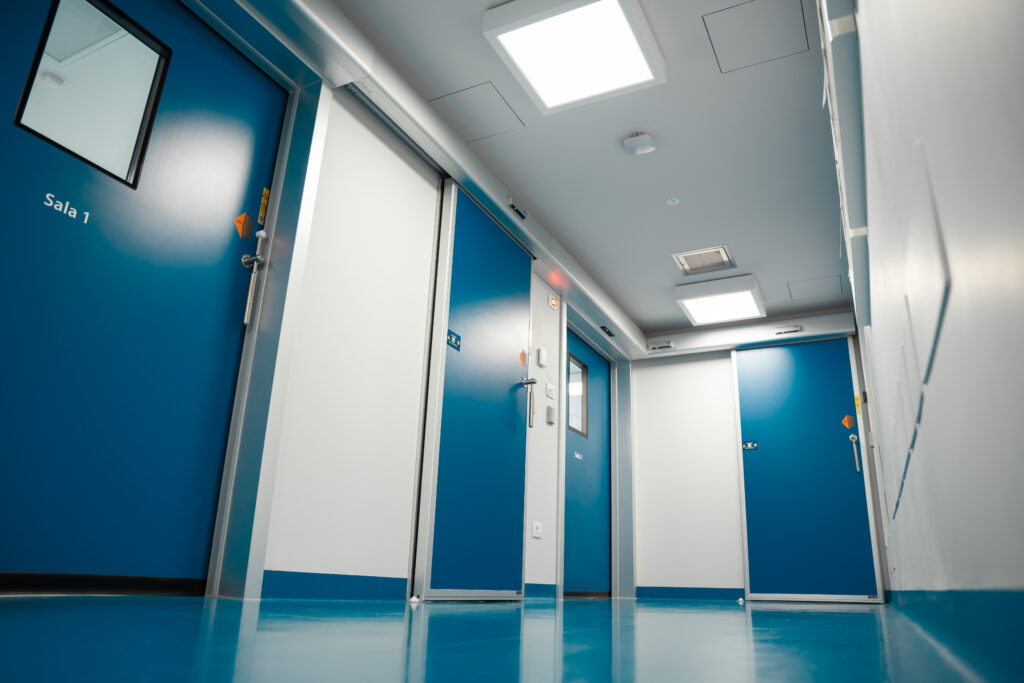
At Tommaso Grandi Dental Clinic in Modena, complex implant procedures are carried out in a facility dedicated to implant surgery, with operating theatres and a team organised to follow each stage of treatment.
This means diagnosis, surgery, prosthetics and follow-up can all be brought together in a single clinical pathway.
Advanced implantology in Modena: technique comes after diagnosis
When a patient arrives with severe bone loss or a complex implant situation, the first question shouldn’t be:
“Which technique should we use?”
The right question is:
“What is the most suitable solution for this situation?”
Only after a specialist visit, analysis of the CT scan and a full assessment of the patient’s anatomy and needs is it possible to decide whether conventional implants, full-arch treatment on four or six implants, zygomatic or pterygoid implants, graftless techniques, regenerative procedures or a combination of approaches are indicated.
This is the principle behind advanced implantology: not adapting the patient to the technique, but choosing the technique based on the patient.
Have you been given a complex diagnosis or told you don’t have enough bone?
A diagnosis of severe bone resorption doesn’t necessarily mean there are no other options.
Request a specialist assessment at Tommaso Grandi Dental Clinic in Modena to look at your situation and understand which implant solutions could be considered in your case.