
The complete guide to understanding whether this solution is right for you.
If you have lost many teeth and have been told that you do not have enough bone for traditional implants, you have probably heard about <strong>zygomatic implants</strong>. But what exactly are they? Do they really work? And above all, what are the pros and cons in your specific case?
In this article, the team at Tommaso Grandi Dental Clinic provides you with a complete and honest guide: no unnecessary technical jargon, just the information you need to make an informed decision.
Zygomatic implants are now one of the most advanced solutions for patients with severe bone atrophy of the upper jaw. However, they are not suitable for everyone — and in this guide, we explain why.
What Is a Zygomatic Implant?
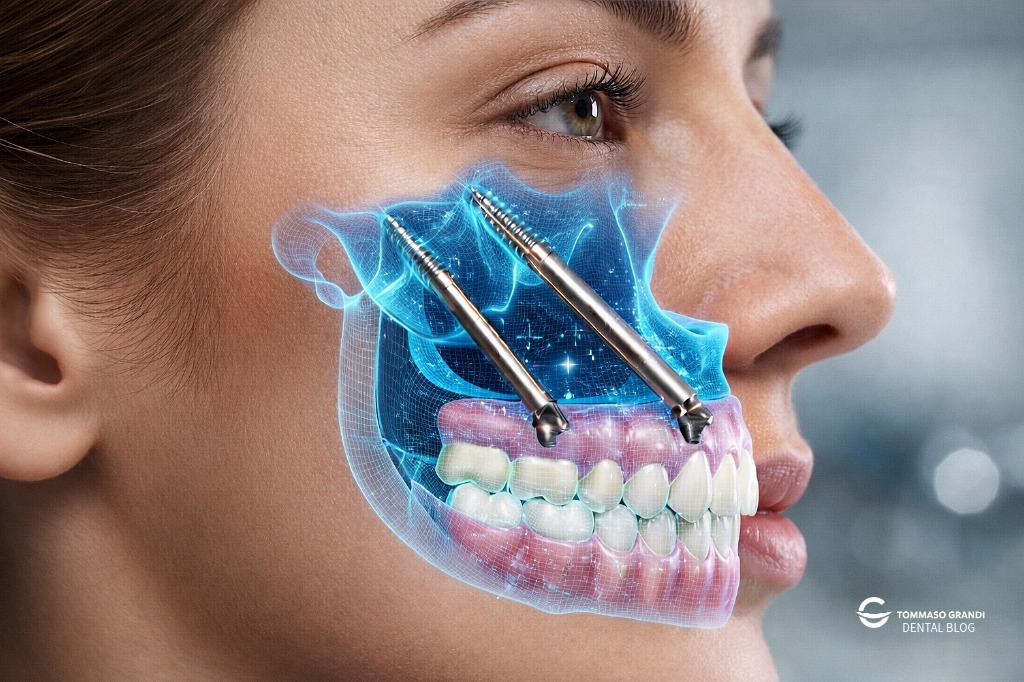
A zygomatic implant is a special type of implant fixture that, instead of being placed into the jawbone like a traditional implant, is anchored to the zygomatic bone — the cheekbone, which is much denser and stronger.
This technique was developed in the 1990s. Today, it is considered a standard of care for cases of severe maxillary bone atrophy.
Zygomatic implants range in length from 30 to 52.5 mm — much longer than a traditional implant, which is usually 8–16 mm — and their design makes it possible to completely avoid bone augmentation procedures such as sinus lifts.
When Are Zygomatic Implants Used?
Zygomatic implants are mainly indicated in three clinical scenarios:
Severe Bone Atrophy
Significant bone loss due to multiple extractions, advanced periodontal disease, prolonged use of removable dentures, or bone diseases.
Failure of Previous Implants
Patients who have already experienced failures with traditional implants or sinus lift procedures, where conventional solutions are no longer feasible.
Oncological Cases
Patients who have undergone bone resections due to oral cavity tumors and require prosthetic rehabilitation.
In all these cases, the traditional solution would first require a bone graft — a long, costly procedure that is not always predictable. Zygomatic implants make it possible to bypass this process entirely.
Zygomatic Implants: Pros and Cons — Quick Summary
Before going into detail, here is a comparative overview:
| ✅ PROS | ⚠️ CONS |
|---|---|
| No Bone Graft Required | More Complex Surgical Technique |
| Fixed Teeth in 24–72 Hours | Not Suitable in Cases of Limited Surgical Access |
| Success Rate of Over 95% at 10 Years | Higher Initial Cost |
| Drastic Reduction in Treatment Time | Requires a Specialist with Specific Training |
| A Definitive Solution Even for Severe Bone Atrophy | More Pronounced Post-Operative Swelling |
| Avoids the Risks of Sinus Lift Procedures | Applicable Only to the Upper Jaw |
| Excellent Chewing Quality | Regular Professional Oral Hygiene Is Required |
The Advantages of Zygomatic Implants in Detail
1
No Need for Bone Grafts
A sinus lift is an effective but lengthy procedure: it requires months of waiting for the grafted bone to mature. With zygomatic implants, this phase is completely skipped, saving time, additional costs, and a further surgical procedure.
2
Immediate Fixed Prosthesis (Day Surgery)
In many cases, a temporary prosthesis can be fitted within 24–72 hours after surgery. The patient leaves the operating room with fixed teeth, without having to wear removable dentures during the healing process.
3
High Success Rate
Clinical studies published in international scientific journals show success rates of over 95% at 10 years after placement — results that are comparable to, and in some cases even higher than, those of traditional implants in high-risk cases.
4
Less Time, Fewer Procedures, Less Stress
A single, decisive surgical procedure instead of a series of operations spread out over time. For a patient who has already endured years of dental problems, this is often the most important factor in making a choice.
5
Restored Quality of Life
Being able to eat, smile, and speak normally again within a short period of time has a profound impact on psychological well-being. Numerous studies report a high level of long-term satisfaction among treated patients.
The Disadvantages of Zygomatic Implants: What You Need to Know
1
Surgical Complexity
The procedure requires specific surgical training, dedicated instrumentation, and often conscious sedation. Not all dental clinics are equipped to perform this procedure. At Tommaso Grandi Dental Clinic, every zygomatic implantology procedure is performed by specialized surgeons and anesthesiologists with advanced training and years of specific experience in this field.
2
Higher Cost
The cost is generally higher than that of traditional implants, due to the surgical complexity and the materials required. That said, when considering the overall cost of the alternative treatment path — bone grafts, waiting time, and implants — the difference is often significantly reduced.
3
Not Suitable for All Patients
It is a specific solution for severe atrophy of the upper jaw. It is neither necessary nor indicated for patients who still have sufficient bone volume. A thorough diagnostic assessment is always required before making any decision.
4
More Demanding Post-Operative Recovery
Swelling, bruising, and pain in the following days can be managed with the prescribed medication and typically resolve within 7–14 days. However, it is still a more invasive procedure than traditional implantology.
5
Requires Dedicated Oral Hygiene
The patient must be motivated and cooperative in the long term: regular professional hygiene sessions and careful at-home oral care are essential to ensure the long-term durability of the treatment.
Who Can Have Zygomatic Implants?
Before proceeding, a thorough multidisciplinary assessment is required. In general, ideal candidates are:
✔ Adult patients with severe bone atrophy of the upper jaw
✔Patients in good general health or with well-controlled systemic conditions
✔ Non-smokers or former smokers (smoking increases the risk of implant failure)
✔ Patients who are motivated to maintain long-term oral care and hygiene
How Much Do Zygomatic Implants Cost?
The cost varies depending on the complexity of the clinical case, the number of implants required, and the type of prosthesis chosen.
At Tommaso Grandi Dental Clinic, we offer personalized treatment plans and installment payment solutions to make even the most complex treatments accessible.
The Clinical Pathway at Tommaso Grandi Dental Clinic
- First visit and diagnosticsClinical examination, medical history collection, 3D cone beam CT scan, and virtual treatment planning.
- Personalized treatment planPresentation of the available treatment options, a detailed cost estimate, and answers to all the patient’s questions.
- Surgical procedurePlacement of the zygomatic implants under sedation, with a possible immediate temporary prosthesis.
- Healing and follow-upRegular check-ups, professional hygiene sessions, and delivery of the final prosthesis.
- Long-term maintenanceAnnual recall plan to ensure the long-term durability of the treatment.
FAQ
Long-term studies show survival rates of over 95% at 10 years. With proper oral hygiene and regular professional check-ups, zygomatic implants can last for the patient’s lifetime.
The procedure is performed under deep local anesthesia or conscious sedation: during the surgery, the patient does not feel pain. In the following days, a feeling of pressure and swelling is normal and can be managed with the prescribed medication.
Age alone is not a contraindication. What matters is the patient’s overall health condition. Many patients over 70 are excellent candidates for this procedure.
All-on-4 uses traditional implants placed at specific angles to make the most of the remaining bone. Zygomatic implants are anchored to the cheekbone and are indicated in cases where there is not enough bone even for All-on-4. In many cases, the two techniques are combined in the same patient.
In patients with severe bone atrophy, zygomatic implants show higher success rates than traditional implants combined with sinus lifts, as they avoid the risks associated with bone grafting. Studies published in peer-reviewed journals report excellent results with 10-year follow-ups.
The information contained in this article is for informational purposes only and does not replace medical advice. Every clinical case is unique and requires a personalized specialist assessment.
Would You Like to Know If You Are the Right Candidate?
Our specialists are available for a personalized, no-obligation assessment. We will analyze your case and propose the solution best suited to your needs.
No Obligation · Initial Assessment Visit · Transparent Cost Estimate