

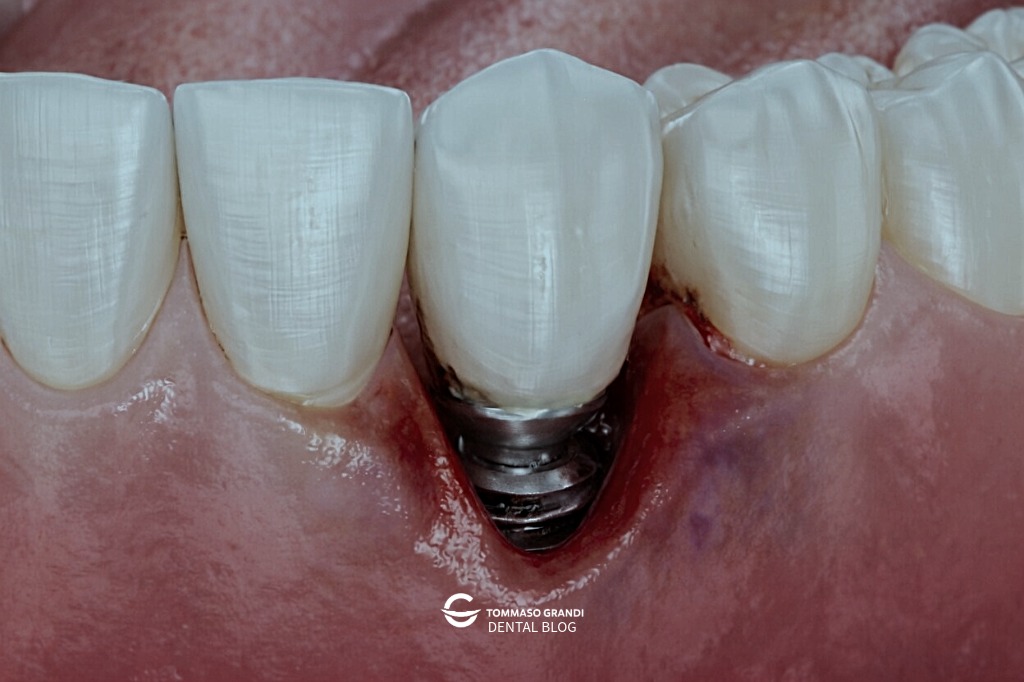
Is your dental implant painful? Does it move? Do you have swelling or pus around the implant? These could be the first signs of a dental implant infection. In this guide you’ll learn how to recognise the symptoms, what to do straight away and when you should call your dentist urgently.
Contents
- What a dental implant infection is
- Symptoms: how to recognise it
- Implant pain after months or years
- A loose implant: what it means
- Peri-implantitis: when infection becomes serious
- Causes and risk factors
- What to do: from the first sign to treatment
- When it’s urgent
- What to do in Modena
- FAQs
Dental implants are today one of the most reliable ways to replace missing teeth: they have well-documented long-term results and can last for decades if properly cared for. Yet, like anything that interacts with living tissue, they can develop infective complications.
Recognising the symptoms of a dental implant infection in time is essential: the difference between conservative treatment and losing the implant can depend on how early it is treated.
Quick answer: the most common signs of infection are persistent pain, swelling, redness, unusual bleeding, pus and a loose implant. If you notice one or more of these symptoms, contact your dentist without waiting.
What a Dental Implant Infection Is
A dental implant infection occurs when bacteria colonise the tissues around the titanium implant – the gum, the peri-implant sulcus or, in more advanced cases, the supporting bone.
There are two main forms, which differ in severity and depth:
- Stage 1 Peri-implant mucositis – The infection affects only the soft tissue (gum) around the implant. It is reversible with appropriate treatment, similar to gingivitis around natural teeth.
- Stage 2 Peri-implantitis – The infection reaches the supporting bone, which starts to resorb. It doesn’t reverse on its own: it needs active treatment and, in advanced cases, surgery.
- Stage 3 Advanced infection / implant loss – Bone loss is extensive and the implant becomes loose. It may need to be removed.
Catching the problem at stage 1 or 2 is the aim of every regular post-implant check-up.
Dental Implant Infection: Symptoms to Recognise
Symptoms vary according to the stage of infection. Some are obvious; others – especially in the early stages – are barely noticeable.
Persistent pain 🔴 Gum swelling 🔴 Pus or discharge 🔴 Unusual bleeding 🔴 A loose implant 🔴 Redness around the implant 🔴 Metallic or bitter taste 🔴 Localised bad breath
Symptoms in the early stages (mucositis)
- Localised redness and swelling around the implant
- Bleeding when probed or when brushing
- Slight tenderness to pressure or chewing
- Slightly altered breath around the implant
Symptoms in the advanced stages (peri-implantitis)
- Spontaneous pain or pain when chewing, sometimes intense
- Marked gum swelling, sometimes with a purplish colour
- Pus coming from the margin around the implant
- A persistent bitter or metallic taste in the mouth
- Gum that “recedes” and exposes the implant
- Implant movement (a serious sign: see the dedicated section)
- In some cases: fever, swelling of the face or neck – an urgent situation
Warning: fever, facial swelling or difficulty swallowing together with implant pain are signs of a spreading infection. Go to A&E or contact your dentist immediately.
Dental Implant Pain After Months or Years: Is It Normal?
This is one of the questions patients ask most often. The short answer: no, implant pain is never normal outside the immediate post-operative period.
Dental implant pain after months
In the first few weeks after placement it’s normal to feel discomfort, swelling and tenderness. All this should settle within 2–4 weeks. If implant pain appears or persists months after surgery, the most likely causes are:
- Failed osseointegration: the implant hasn’t fused properly with the bone
- A developing bacterial infection (mucositis or early peri-implantitis)
- Occlusal overload: the implant crown is pressing incorrectly when you chew
- Incorrect positioning of the prosthesis, interfering with the nerve
Dental implant pain after years
If an implant that has worked well for years suddenly starts to hurt, it’s a sign that something has changed. The most common causes of implant pain after years include:
- Late peri-implantitis: infection can develop long after placement, especially in people who don’t attend regular check-ups
- Fracture of the implant or screw: rare but possible, especially in patients with bruxism
- Progressive bone loss that destabilises the implant
- Wear or breakage of the crown, altering the chewing load
Rule of thumb: a well-integrated implant shouldn’t hurt. Any pain that appears after initial healing deserves a specialist assessment, even if mild or intermittent.
A Loose Dental Implant: What It Means (Even Without Pain)
Feeling your implant move under your tongue or when chewing is one of the most worrying signs – and often one of the most overlooked, especially when there is no pain.
A loose implant with no pain: is it less serious?
No. A dental implant that moves without pain isn’t necessarily less serious than one that hurts. The absence of pain may mean that bone loss has happened gradually, giving the tissues time to adapt, but the structural problem is the same – or even more advanced.
Why does an implant become loose?
- Failed osseointegration: the bone hasn’t fused with the implant surface
- Advanced peri-implantitis with severe bone loss around the implant
- Implant fracture (the implant breaks but stays in place)
- Loosening of the connection between the implant and the abutment (in this case it’s the crown that moves, not the implant)
A loose implant needs urgent assessment. Don’t try to “fix” it yourself. Contact your dentist or implant specialist as soon as possible: in some cases the implant can still be saved with prompt treatment.
Peri-implantitis: Symptoms and Why It’s Important to Recognise It
Peri-implantitis is the most serious form of dental implant infection: an inflammatory and infective process that involves not only the gum but also the bone supporting the implant. It is considered the main cause of long-term dental implant loss.
Peri-implantitis: specific symptoms
- Spontaneous bleeding, or bleeding on touch, around the implant
- Deep peri-implant pockets (detectable only by probing at the clinic)
- Pus coming from the pocket
- Red, swollen gum that may recede and expose the implant
- Pain when chewing or on pressure
- Bone loss visible on X-ray (often in a “crater” shape around the implant)
Why peri-implantitis is insidious: in the early stages it can cause almost no symptoms. The patient feels no pain and sees nothing unusual – but meanwhile the bone is being resorbed. That’s why regular check-ups with probing and X-rays are essential for anyone with implants.
If you’d like to learn more about peri-implantitis, its specific causes and current treatment protocols, we have a guide dedicated entirely to this topic.
Causes and Risk Factors for Implant Infection
Understanding the causes helps prevent the problem and identify the patients most at risk.
Main causes
- Inadequate oral hygiene: plaque building up around the implant is the main trigger
- Untreated pre-existing periodontitis: people who have had gum disease are more prone to peri-implantitis
- Smoking: reduces blood supply to the bone and impairs the local immune response
- Uncontrolled diabetes: affects the tissues’ ability to heal
- Bruxism: excessive forces destabilise the bone around the implant over time
- Excess cement left under the gum when the crown was fitted
Factors that increase the risk
- Lack of regular post-implant check-ups
- Poor bone quality or quantity at the time of placement
- Use of medicines that affect bone metabolism (e.g. bisphosphonates)
- Radiotherapy to the head and neck
What to Do If You Suspect an Implant Infection
The right course of action depends on the stage of the infection, but some general rules always apply.
What to do straight away (at home)
- Don’t ignore the symptoms: contact your dentist, even just for advice over the phone
- Keep cleaning the area gently – don’t stop
- Use 0.2% chlorhexidine rinses if you already have some at home (not long term without medical advice)
- Avoid hard foods or direct pressure on the implant
- Don’t take antibiotics on your own without a prescription: it won’t solve the problem and may mask it
Professional treatment: the stages
Stage 1 – Diagnosis and staging
The dentist or implant specialist carries out peri-implant probing, periapical X-rays or a 3D CBCT scan to assess the extent of bone loss, and an analysis of your oral hygiene.
Stage 2 – Non-surgical treatment (mucositis and mild peri-implantitis)
- Scaling and decontamination of the implant surface
- Home hygiene instruction and motivation
- Local or systemic antibiotic therapy if indicated
- Reassessment after 4–8 weeks
Stage 3 – Peri-implant surgery (moderate to advanced peri-implantitis)
- Surgical access to decontaminate the implant surface
- Guided bone regeneration (GBR) in cases with significant bone defects
- In extreme cases: removal of the implant and planning a new placement after healing
At our clinic we manage implant complications with a precise diagnostic protocol: peri-implant probing, dedicated X-rays and, where necessary, a 3D CBCT scan to assess the exact extent of bone loss. The treatment plan is built around the individual case – from conservative treatment to surgery – with the aim of saving the implant whenever possible.
When It’s Urgent: Signs You Can’t Ignore
Contact your dentist immediately (or go to A&E) if you have:
- Fever together with implant pain
- Swelling of the face, cheek or neck
- Difficulty opening your mouth (trismus)
- Difficulty swallowing
- A lot of pus with a strong smell
- Sudden, intense pain that doesn’t respond to painkillers
- An implant that visibly moves
These symptoms may indicate an infection that has spread to the deeper tissues (abscess, cellulitis) and needs urgent treatment – sometimes in hospital.
Dental Implant Infection in Modena: Where to Go
If you live in or near Modena and have an implant that hurts, moves or shows signs of infection, the most important thing is not to wait. Every week of delay can mean more bone loss and more invasive treatment.
Tommaso Grandi Dental Clinic – Modena
We have specific experience in managing implant complications, from mucositis to advanced peri-implantitis. We offer:
- A dedicated implant visit with probing and X-ray diagnostics
- Non-surgical and surgical decontamination protocols
- Guided bone regeneration in cases of bone loss
- Complete case management, from diagnosis to definitive treatment
If your implant was placed elsewhere, that’s not a problem: we also assess and treat second-opinion cases.
FAQs – Frequently Asked Questions About Dental Implant Infection
How can I tell if my dental implant is infected?
The most common signs are persistent pain, swelling and redness of the gum around the implant, unusual bleeding, pus, a bitter taste in the mouth and a loose implant. In some cases the infection is silent and can only be detected with probing and X-rays at the clinic.
Is dental implant pain after years normal?
No. A well-integrated implant shouldn’t hurt after initial healing. Implant pain after years is almost always a sign of a complication – peri-implantitis, fracture, bone loss – that should be assessed by a specialist before it gets worse.
What should I do if implant pain appears after months?
Contact your dentist for a check-up with probing and an X-ray. Don’t take antibiotics on your own: they could mask the problem without solving it. The sooner the cause is found, the simpler the treatment.
Can a loose implant be saved?
It depends on the cause. If it’s the crown that moves (not the implant), it can often be fixed easily. If the implant itself moves, osseointegration has been lost: in some cases treatment is still possible, in others the implant must be removed. The sooner you act, the better the chances of saving it.
What is the difference between peri-implant mucositis and peri-implantitis?
Mucositis affects only the gum and is reversible with treatment. Peri-implantitis also involves the bone, which is progressively resorbed: it doesn’t reverse on its own and needs active treatment. Peri-implantitis is the main cause of long-term implant loss.
Can an implant be replaced after being lost to infection?
Yes, in most cases. After the infected implant is removed, the tissues are left to heal fully (usually 3–6 months) and, if necessary, bone regeneration is carried out. A new implant can then be placed. Your dentist will assess timing and feasibility case by case.
How often should I have check-ups after an implant is placed?
At least once a year, even without symptoms. For patients at higher risk (smokers, people with diabetes, those who have had periodontitis), every 6 months is recommended. Regular check-ups with probing and X-rays are the main way to catch peri-implantitis early, when it is still easier to treat.
Medical disclaimer: the information in this article is for general purposes only and does not replace the advice of a dentist or implant specialist. If you have acute symptoms or rapid worsening, always contact a professional or go to A&E.
Do you have an implant that hurts or moves?
Don’t wait for the problem to get worse. The sooner you act, the simpler – and less invasive – the treatment.
Dedicated implant visit, precise diagnosis, tailored treatment plan.