

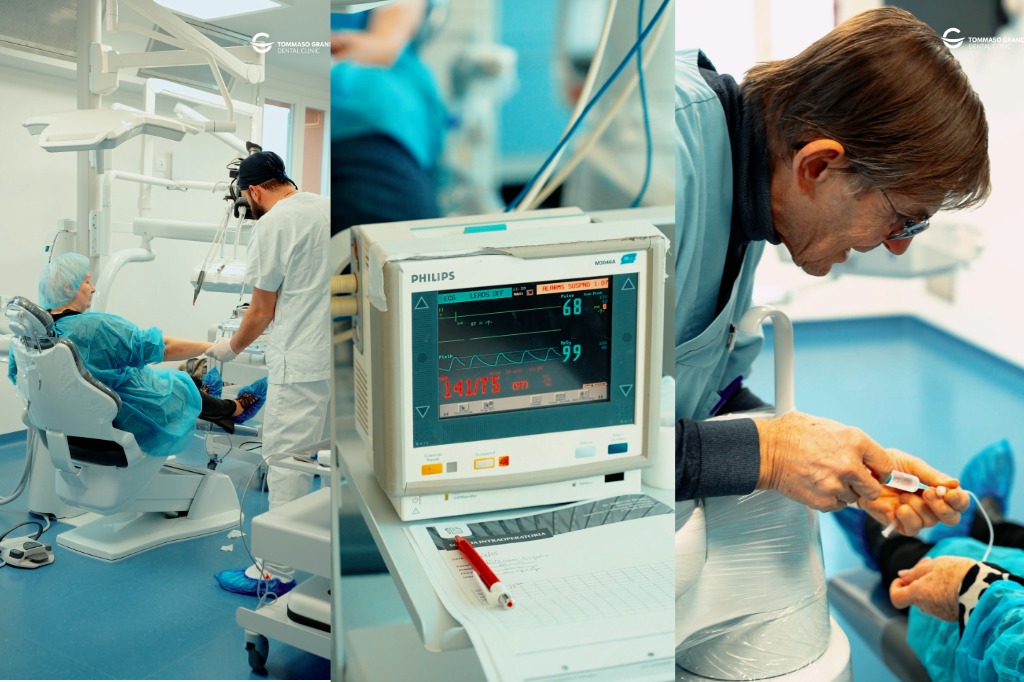
Are you afraid of the dentist? You are not alone: it is estimated that around 15% of people in Italy experience odontophobia, an intense fear of dental treatment. Conscious sedation at the dentist is an option more and more patients choose in order to get through extractions, implant treatment and root canal treatment with less anxiety and less discomfort.
In this complete guide you will find everything you need to know: what it is, how it works, what it can cost, who it may be suitable for and how to prepare.
Quick answer: Conscious sedation at the dentist is a technique that, using medicines given intravenously or by inhalation, helps reduce anxiety and discomfort during dental treatment. You remain awake and able to cooperate, but in a state of deep relaxation.
What is conscious sedation at the dentist?
Dental conscious sedation (also called in-surgery sedation or sleep dentistry) is a pharmacological sedation technique that induces a state of deep relaxation and reduced anxiety, while the patient remains awake, able to breathe independently and able to respond to the dentist’s instructions.
Unlike general anaesthesia, it does not require an operating theatre or intubation. It can be carried out in a suitably equipped dental practice or in specialised clinics.
Which dental procedures is it used for?
- Wisdom tooth extraction (especially if the tooth is impacted)
- Dental implantology and complex implant surgery
- Bone grafts and sinus lift
- Root canal treatment (endodontics) for anxious patients
- Deep professional cleaning for patients with severe gum disease
- Dental treatment for patients with physical or cognitive disabilities
- Children who need extensive treatment and find it hard to cooperate
- Patients with a pronounced gag reflex
How does conscious sedation at the dentist work?
The protocol follows clearly defined stages, from the pre-operative assessment through to recovery after the procedure.
1. Pre-operative assessment visit
Before sedation, the dentist or anaesthetist will take a full medical history: conditions, allergies, medicines being taken, and habits. The ASA classification will be used to assess the anaesthetic risk.
2. Preparation on the day of the procedure
The patient should arrive having fasted (6–8 hours for solids, 2 hours for clear liquids). A venous cannula is placed for the intravenous administration of the medicines.
3. Administration of the sedative medicines
The clinician administers the medicines gradually, monitoring the patient’s response, until the desired level of sedation is reached before treatment begins.
4. During treatment
The patient is monitored continuously with a pulse oximeter, a blood pressure monitor and an ECG. The dentist carries out the procedure while the patient’s perception of pain is reduced and anxiety is eased.
5. Recovery after the procedure
Afterwards, the patient remains in a recovery room for 30–60 minutes and is discharged only once their vital signs are stable.
Please note: You must be accompanied by an adult. You should not drive until the following day. Please arrange this in advance.
Conscious sedation with nitrous oxide at the dentist
Nitrous oxide (N2O), known as “laughing gas”, is the most widely used method of sedation in dentistry, especially for children and for patients with mild to moderate anxiety.
Advantages of nitrous oxide
- A rapid effect that is easy to control
- It wears off almost immediately (5–10 minutes after it is stopped)
- The patient can drive after the procedure
- Suitable for children: no needles or cannulas are required
- It reduces the gag reflex
Limits of nitrous oxide
- Lighter sedation: suitable for mild anxiety, not for long, invasive procedures
- It does not eliminate pain: it should be combined with local anaesthetic
- It is contraindicated in the first trimester of pregnancy and in severe COPD
Intravenous conscious sedation at the dentist
For complex procedures or severe odontophobia, intravenous sedation is used. The medicines most often used are midazolam, propofol and fentanyl, often in combination.
Advantages of intravenous sedation
- Deeper, more controllable sedation than with N2O
- An amnesic effect: patients often do not remember the procedure
- Well suited to long procedures such as full-arch implant treatment
- It can allow several teeth to be treated in a single session
Please note: Intravenous sedation at Tommaso Grandi Dental Clinic is carried out by certified anaesthetists who remain present throughout the procedure.
How much does conscious sedation at the dentist cost?
The cost of conscious sedation varies from clinic to clinic and depends on the type of sedation chosen and the complexity of the procedure.
Tommaso Grandi Dental Clinic: the cost of sedation is always included in the estimate, which you will receive at the end of your first visit. There are no surprises and no hidden costs: you will know exactly what you will pay before any treatment begins.
Is sedation covered by the NHS (SSN)?
In general, dental sedation is not covered by the Italian National Health Service (Servizio Sanitario Nazionale) for adult patients without particular medical conditions. Exceptions include patients with certified disabilities and, in some Regions, specific groups. Always check with your local health authority (ASL).
Who can have conscious sedation at the dentist?
Typical candidates
- Patients with odontophobia (an intense fear of the dentist)
- Patients with a pronounced gag reflex
- Anyone facing a long or invasive procedure
- Patients with physical or cognitive disabilities
- Children who are particularly anxious or who need extensive treatment
Main contraindications
- A known allergy to sedative medicines
- Pregnancy (first trimester for N2O; intravenous sedation to be assessed)
- Severe respiratory conditions (severe COPD, untreated sleep apnoea)
- Unstable cardiovascular disease
- Taking incompatible medicines (for example MAO inhibitors, anticoagulants)
How to prepare for conscious sedation at the dentist
The day before
- Avoid alcohol and recreational drugs in the day before your appointment
- Do not change your usual medicines unless your clinician advises you to
- Arrange for someone to accompany you home
On the day of the procedure
- Fast from 6–8 hours beforehand (solids and alcoholic drinks)
- You may drink water or clear liquids until 2 hours beforehand
- Do not smoke in the 8 hours beforehand
- Wear comfortable clothes with sleeves that can be rolled up
- Bring a list of the medicines you take
After sedation
- Remain under observation at the practice for at least 30–60 minutes
- Have someone accompany you home: do not drive until the following day
- Rest for the remainder of the day
- Eat light, soft foods in the first few hours
- Tell your dentist about any unusual symptoms (persistent pain, fever, swelling)
FAQ: frequently asked questions about sedation at the dentist
Does conscious sedation at the dentist put you to sleep?
Not necessarily. With moderate doses the patient remains awake, but in a state of drowsiness and relaxation. Because of the amnesic effect of the medicines, many patients do not remember the procedure, even though they were technically awake.
Is it different from general anaesthesia?
Yes, substantially. General anaesthesia requires intubation and mechanical ventilation. Conscious sedation is less invasive, with a much quicker recovery and fewer side effects.
Can I have sedation if I am pregnant?
Nitrous oxide is generally avoided in the first trimester. In the second it may be used with caution. Intravenous sedation should be assessed case by case with your obstetrician. Always tell your dentist if you are pregnant, or if you think you might be.
How long does the effect of sedation at the dentist last?
With nitrous oxide the effects wear off in 5–10 minutes. With intravenous sedation, recovery is generally complete in 1–2 hours, but residual effects on your reflexes may last until the following day.
What tests are needed before sedation at the dentist?
Typically: a complete blood count, coagulation tests (PT, PTT, INR), blood glucose, and kidney and liver function. For older patients or those with heart disease, an ECG is also requested. For simple procedures in healthy people, the tests may be kept to a minimum.
Conclusion
If fear of the dentist has led you to put off important treatment, conscious sedation can change your relationship with oral health. When it is indicated, it can help you look after your mouth with less anxiety, and it is increasingly offered in dental practices.
Ask your dentist whether they offer this service, check that an anaesthetist is present for intravenous sedation, and do not hesitate to ask any questions you have. Your dental health matters — and you should not have to go through treatment in distress in order to look after it.
Medical disclaimer: The information in this article is for general information only and does not replace the advice of a doctor or a dentist. Always consult your dentist or a specialist for a personalised assessment.
Related articles
Are you afraid of the dentist, or of pain?
With conscious sedation you can go through treatment more calmly and under close monitoring, with an anaesthetist present and a pathway tailored to you. To find out more or to book a first visit, we can explain whether conscious sedation is suitable in your case and how it works, step by step.