

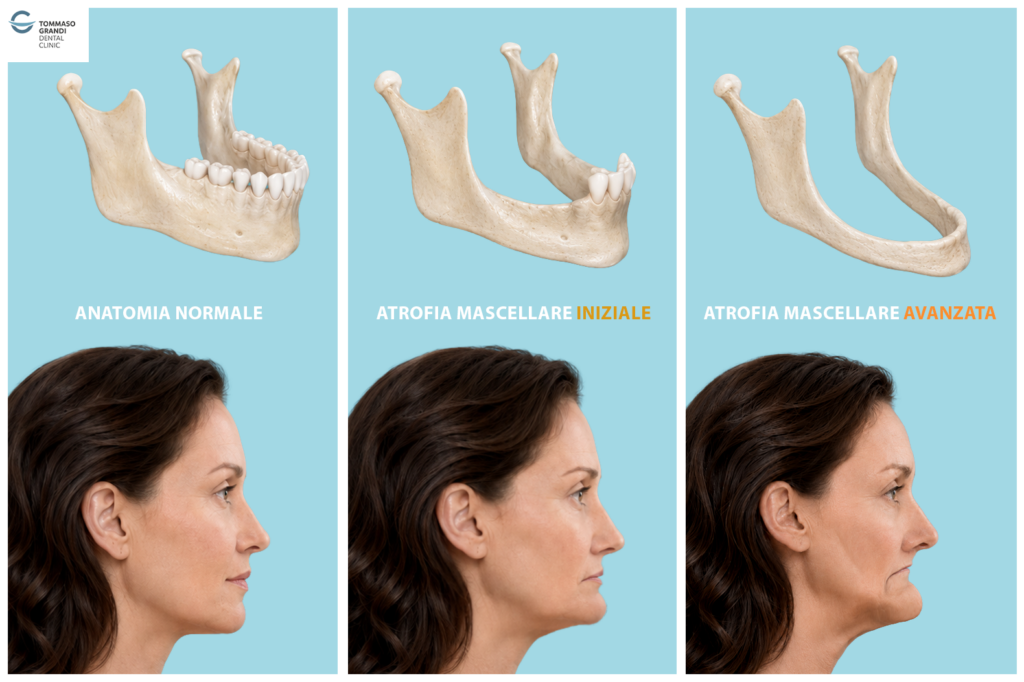
Have you lost one or more teeth and been told by your dentist that you don’t have enough bone? You’re not alone. Bone atrophy is one of the most common reasons why placing traditional dental implants becomes complicated – but it doesn’t mean implants are impossible.
Thanks to advanced implant techniques, today it is often possible to have stable, fixed teeth even with limited bone, without giving up function or the appearance of your smile. In this guide you’ll find everything you need to know: the causes of atrophy, the options available and how to choose the right one for you.
Why the jawbone matters for implants
The jawbone is the foundation in which dental implants are anchored. It works just like the natural root of a tooth: it must be wide, tall and dense enough to provide stability over time.
When a tooth is lost, however, the bone in that area gradually starts to resorb – a process called bone atrophy. The longer it has been since the tooth was lost, the more bone is lost. This is one of the reasons why it’s important to act promptly.
Did you know? Bone loss is fastest in the first year after a tooth is lost, and a significant amount of volume can be lost in that area. After a few years, the atrophy can be considerable.
Dental implants with little bone: the 3 main options
When there isn’t enough jawbone for traditional implants, there are three advanced approaches – each suited to different situations.
Option 1
Zygomatic implants
Longer implants anchored in the zygomatic bone (cheekbone), which is much more robust than the upper jaw. Indicated for severe atrophy of the upper jaw. They allow fixed teeth with immediate loading, in suitable cases, without bone grafts.
Zygomatic implants are an established option for patients with severe bone atrophy of the upper jaw. Instead of relying on the remaining jawbone, these implants – longer than traditional ones – are anchored directly in the zygomatic bone, which is structurally more solid and not subject to the same kind of resorption.
The main advantage is the possibility of having fixed teeth with immediate loading (in suitable cases), often without the need for preliminary bone grafts. They are particularly suitable when a sinus lift isn’t feasible or when the patient wants to keep treatment time to a minimum.
Read more: Zygomatic implants: pros and cons
Option 2
Pterygoid implants
These are anchored in the pterygoid plates, where highly mineralised cortical bone remains. Well suited to the back of the upper jaw. They avoid more invasive procedures and long recovery times.
Pterygoid implants are placed in the back of the upper jaw, anchored in the pterygoid plates – a dense, mineralised bone structure that remains intact even when the rest of the upper jaw has atrophied.
This approach can avoid sinus lift procedures in the back molar area, reducing the overall invasiveness of treatment and shortening recovery time.
Read the article: Pterygoid implants: what they are, when they’re needed and why they may avoid bone grafting
Option 3
Sinus lift
A surgical procedure that increases the height of the bone in the upper jaw by adding graft material. It requires a healing period before the implants are placed, but allows standard implants to be used.
A sinus lift is a bone regeneration technique used when the height of the bone in the upper jaw is insufficient for standard implants. The surgeon gently lifts the sinus membrane and places graft material to stimulate the formation of new bone.
After a healing period – usually 4 to 9 months – the regenerated bone is solid enough to receive implants. It is a well-established solution with good long-term clinical evidence.
Read the article: Is bone regeneration always necessary? When it may be avoided with immediate loading
Advantages of implants with little bone compared with removable dentures
Fixed implants
- Stability and everyday comfort
- Natural chewing
- No worries about the teeth moving or falling out
- Helps preserve the remaining bone
- Natural-looking, long-lasting result
Removable dentures
- Instability when chewing
- Need for adhesives or relining
- Accelerate bone resorption
- Reduced comfort over the long term
- Negative aesthetic and psychological impact
How the most suitable solution is chosen
There is no single solution that suits everyone. The choice depends on a careful assessment of several factors:
- Extent of bone atrophy: mild, moderate or severe
- Area involved: upper or lower jaw, front or back
- Patient’s general health: any systemic conditions or current medication
- Time available: some solutions require longer healing phases than others
- The patient’s aesthetic and functional goals
That’s why it’s essential to choose a clinician experienced in advanced implantology who can plan tailored treatment – supported by diagnostic technology such as 3D cone beam CT.
Frequently asked questions about implants with little bone
Yes, in many cases. Thanks to advanced techniques such as zygomatic implants, pterygoid implants and sinus lift, stable dental implants are possible even with significant bone atrophy.
They are longer than traditional implants and anchored in the zygomatic bone rather than the upper jaw. They are indicated for severe upper jaw atrophy and often allow fixed teeth without preliminary bone grafts.
They are implants placed in the back of the upper jaw, anchored in the pterygoid plates – a dense, mineralised bone structure. They can avoid the need for a sinus lift in that area.
It is a surgical procedure that increases bone height in the upper jaw with a bone graft. After a healing period, the regenerated bone allows standard implants to be placed, with well-documented long-term results.
It depends on the technique. Zygomatic and pterygoid implants can lead to fixed teeth with immediate loading (in suitable cases) (As a guide: surgery takes 2–4 hours; with immediate loading, in suitable cases, a temporary prosthesis is fitted shortly after surgery, followed later by the final one. Full integration of the implant into the bone usually takes around 3 months). A sinus lift, by contrast, requires a bone healing period of 4–9 months before implants are placed.
Procedures are carried out under local anaesthesia or conscious sedation. Post-operative discomfort can be managed with common painkillers and settles within a few days. The technique chosen affects the overall invasiveness.
The cost varies according to the technique used, the number of implants needed and the complexity of the case. A personalised assessment is the first step to receiving a precise, transparent quote. Book a first visit.
Lost bone doesn’t regenerate on its own, but guided bone regeneration and grafts can restore enough volume to place implants. Alternatively, zygomatic and pterygoid implants can work around the problem without grafts.
Please note: this content is for information only and does not replace an individual clinical assessment. Every case of bone atrophy must be assessed by an experienced clinician.
Not enough bone and want to know if implants are possible? We’re in Modena.
At Tommaso Grandi Dental Clinic we assess each case with 3D cone beam CT and explain clearly which solutions are suitable for you – in plain language.
Book an implant consultation and find out which treatment pathway is most suitable for your case.