

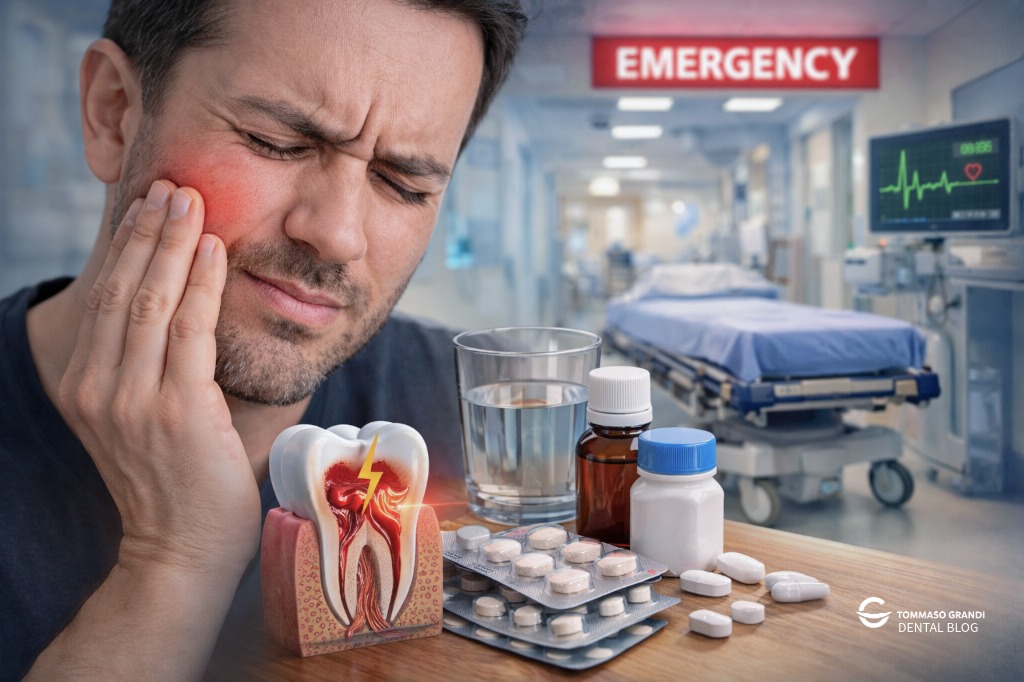
Everything you need to know to manage acute pain, find quick relief and understand when you urgently need to see a dentist in Modena.
Contents
- What causes toothache?
- Immediate remedies for toothache
- Natural remedies: what really works
- Can I go to hospital with toothache?
- When to see a dentist in Modena
- Frequently asked questions
Toothache is one of the most intense and debilitating kinds of pain you can experience. It can wake you at night and make it hard to eat, speak and concentrate. Yet many people don’t know what to do straight away: whether to go to hospital or wait for the dentist, which remedies can give quick relief and which situations need urgent attention.
In this guide, the team at Tommaso Grandi Dental Clinic in Modena answers all these questions with clear, up-to-date information. You’ll find advice on the most effective remedies, how to act in an emergency and when professional treatment is needed.
What causes toothache?
Before talking about remedies, it helps to understand the most common causes of toothache. Dental pain varies: it can be throbbing, constant, sharp or widespread, and its nature helps show what is happening and how urgently you need to act.
Deep decay: when it reaches the dental pulp, the pain becomes sharp and spontaneous, often made worse by cold and sweet things.
Pulpitis: inflammation of the dental pulp. It causes intense, prolonged pain, often worse at night.
<br/><strong>Ascesso dentale</strong><br/>Infezione batterica con accumulo di pus. Può causare gonfiore e febbre e richiede trattamento urgente.<br/>
Wisdom tooth: eruption in an abnormal position can cause intense pain, swelling and difficulty opening the mouth.
Bruxism: grinding your teeth at night causes progressive wear and widespread pain in the jaw and chewing muscles.
Broken or lost filling: this exposes the tooth to external stimuli, causing sharp pain and increasing the risk of new decay.
Identifying the cause is essential, but it often can’t be done on your own. Even when the pain settles temporarily, you always need to see a dentist for a definitive diagnosis and appropriate treatment.
Immediate remedies for toothache
—
- 1 Apply cold to the outside – Place an ice pack wrapped in a cloth on the outside of your cheek for 15–20 minutes, with breaks of the same length. Cold reduces swelling and eases pain by narrowing local blood vessels. Don’t apply ice directly to the skin.
- 2 Body position – Avoid lying completely flat: a horizontal position increases blood flow to the head and can intensify throbbing pain. Keep your head slightly raised, especially at night.
- 3 Avoid foods and drinks that make the pain worse – Very cold, very hot, sweet or acidic foods can stimulate the inflamed nerve. Choose foods at room temperature and chew on the opposite side from the painful tooth.
- 4 Gentle oral hygiene – Keep the area clean with very gentle brushing and rinses with lukewarm water to avoid a build-up of bacteria that could worsen the inflammation.
Be careful with heat: never apply heat to your face if you have toothache. Heat dilates blood vessels and can speed up the spread of any infection, making both swelling and pain worse.
Natural remedies for toothache: what really works
Among natural remedies for toothache, some have a stronger scientific basis than others. Here are the main ones, with an honest look at how well they actually work.
| Remedy | How to use it | Perché può aiutare |
|---|---|---|
| Olio di chiodi di garofano | Applicare una piccola quantità sul dente con un cotton fioc | — |
| Sciacqui con acqua salata | — | — |
| Impacco di ghiaccio esterno | Borsa del ghiaccio avvolta in un panno sulla guancia, 15-20 minuti con pause | — |
| Aglio fresco | Pasta di aglio schiacciato applicata localmente sul dente | — |
| Sciacqui con infuso di camomilla | Infuso tiepido (non caldo), sciacqui delicati | — |
Temporary remedies, not definitive solutions: no natural remedy treats the cause of toothache. Decay doesn’t disappear with clove oil. An abscess isn’t cured with salt water. These approaches help you feel better in the hours before your dental appointment, which remains the only definitive solution to the problem.
Can I go to hospital with toothache?
This is one of the most common questions: can I go to hospital with toothache? The answer is yes, but with important distinctions about when the emergency department (A&E) is the right choice and when it’s better to go straight to a dentist.
When A&E is necessary
—
- Rapid swelling of the face or neck with difficulty breathing or swallowing – This may indicate a spreading abscess (cervicofacial cellulitis) that could obstruct the airway. It is a medical emergency requiring immediate hospital treatment.
- A temperature above 38.5°C together with toothache – A sign that the infection is spreading through the body. It needs urgent medical assessment and possibly hospital treatment.
- Dental injury with heavy bleeding or a knocked-out tooth – If a tooth has come completely out of its socket, it may be possible to re-implant it if treated within 30–60 minutes. Keep the tooth in milk or saline solution and go immediately to a dentist or A&E.
- Pain that can’t be controlled with any remedy – A&E can provide pain relief and direct you to the most appropriate urgent dental care.
What A&E can and can’t do
—
For intense toothache without the emergency symptoms described above, A&E won’t solve the underlying problem: it doesn’t have the equipment for fillings, root canal treatment or planned extractions. In these cases it is quicker and more effective to contact your own dentist or a clinic that handles dental emergencies, such as Tommaso Grandi Dental Clinic in Modena.
Emergency dental service: some hospitals offer an emergency dental service at weekends and on public holidays. Before going to A&E for non-emergency dental pain, check whether your local hospital offers this service, or contact our clinic in Modena directly to check availability for urgent appointments.
What A&E can and can’t doWhen to see a dentist in Modena (and why not to wait)
The most direct answer is: as soon as possible. Toothache isn’t a signal to ignore or to manage indefinitely with home remedies. In the vast majority of cases, the underlying problem gets worse if it isn’t treated professionally and promptly.
When to see a dentist in Modena (and why not to wait)Some signs that you need an urgent appointment:
- 1 Pain lasting more than a day or two – Persistent pain almost always indicates an active problem that needs professional diagnosis and treatment.
- 2 Spontaneous, throbbing pain – Often a sign of irreversible pulpitis or an abscess. The sooner it is treated, the more likely it is that the tooth can be saved and complications avoided.
- 2 Spontaneous, throbbing pain – Often a sign of irreversible pulpitis or an abscess. The sooner it is treated, the more likely it is that the tooth can be saved and complications avoided.3 Intense sensitivity to heat with lingering pain – If the pain lasts more than 20–30 seconds after a hot stimulus, the pulp may be irreversibly damaged and need root canal treatment.
- 4 Swelling of the gum or face, even mild – Any swelling in the mouth or face indicates an ongoing infection that shouldn’t be underestimated or treated with home remedies alone.
- 5 The pain has suddenly stopped without treatment – This may indicate pulp necrosis: the nerve tissue has died and no longer transmits pain, but the infection can continue silently and lead to an abscess.
Dental emergencies in Modena: Tommaso Grandi Dental Clinic. Tommaso Grandi Dental Clinic in Modena handles dental emergencies and offers prompt first appointments. Our team is experienced in treating deep decay, infections, root canal treatment (endodontics) and oral surgery. Don’t wait for the pain to get worse: contact us to book an urgent appointment.
Frequently asked questions
—
—
—
—
—
—
Tommaso Grandi Dental Clinic – Clinical editorial team. Article written by the clinical team at Tommaso Grandi Dental Clinic in Modena. The information is for general purposes and does not replace the advice of a dentist. If you have toothache, always consult a specialist. The information in this article is for information purposes only. It does not constitute a medical diagnosis or treatment advice. Always consult a qualified dentist about any oral health problem.
Do you have toothache in Modena?
—