

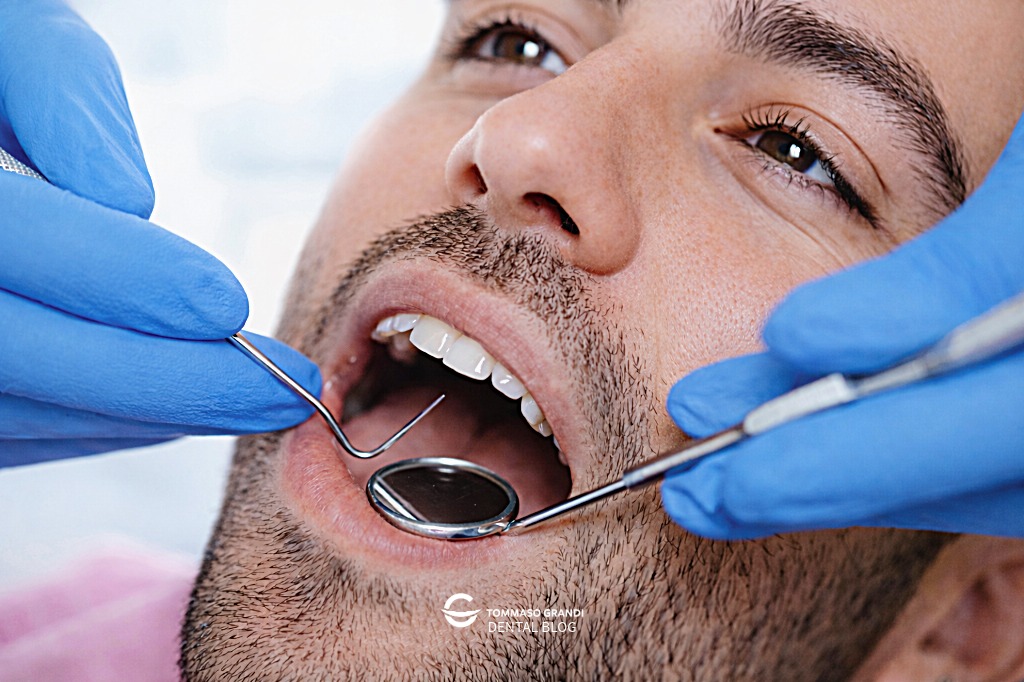
It’s one of the most frequently asked questions, yet the answer isn’t the same for everyone. In this guide from Tommaso Grandi Dental Clinic in Modena, you’ll find out the right frequency for your situation, what happens during a professional hygiene session and why you shouldn’t wait for a problem to appear before booking one.
Contents
- The quick answer: how often to have a clean
- The quick answer: how often to have a cleanWhat a professional clean is
- The right frequency for your situation
- What happens during the session
- Cleaning teeth with dental implants
- Myths about professional cleaning
- Home care: what to do between sessions
- Teeth cleaning in Modena
- FAQs
How often should you have your teeth professionally cleaned?
The standard answer, recommended by most international dental guidelines, is every 6 months. But this is a general rule: in clinical practice the ideal frequency varies from person to person depending on several factors.
Quick answer: for most healthy adults, a professional clean is recommended every 6 months. For people with inflamed gums, periodontitis, dental implants or who smoke, the recommended frequency is every 3–4 months. For those with very good oral hygiene and no risk factors, once a year may be enough.
What a Professional Clean Is (and Why Brushing Isn’t Enough)
A professional clean – also called professional dental hygiene, scale and polish or scaling – is a procedure carried out by a dental hygienist or dentist that removes deposits that even the most careful brushing can’t.
What a Professional Clean Is (and Why Brushing Isn’t Enough)What does a professional clean remove?
- Supragingival tartar: hardened deposits visible above the gumline, formed when plaque mineralises
- Subgingival tartar: deposits that build up in the gum pockets, invisible and out of reach of everyday home tools
- Plaque in hard-to-reach areas (between teeth, back surfaces)
- Surface stains from coffee, tea, red wine or smoking (with a final polish)
Tartar is the main cause of gum inflammation (gingivitis) and, if not removed, can progress to periodontitis – the disease that destroys the bone supporting teeth and implants. Once it has formed, no home technique, however careful, can remove it.
Did you know? Plaque can start to harden into tartar within just a few days if it isn’t removed. That’s why consistent daily home hygiene is just as important as regular professional sessions.
How Often to Have Your Teeth Cleaned: the Right Frequency for Each Situation
How Often to Have Your Teeth Cleaned: the Right Frequency for Each SituationThere’s no universal answer. The ideal frequency depends on your oral health, your habits and your risk factors. Here’s a practical guide.
🟢 Once a year
Adults with very good hygiene, healthy gums, no risk factors and little tendency to form tartar
Adults with very good hygiene, healthy gums, no risk factors and little tendency to form tartar🟡 Every 6 months
The standard recommended frequency for most adults in good oral health
The standard recommended frequency for most adults in good oral health🟠 Every 3–4 months
Patients with periodontitis, dental implants or sensitive gums, smokers, people with diabetes, or those with a strong tendency to form tartar
Patients with periodontitis, dental implants or sensitive gums, smokers, people with diabetes, or those with a strong tendency to form tartar🔴 As advised by your specialist
Patients in active periodontal treatment or after surgery: the frequency is set case by case
Who should have a clean every 3–4 months?
- Patients with periodontitis or a history of gum disease: bacteria quickly recolonise the gum pockets, so closer monitoring is needed
- Patients with dental implants: the implant surface collects plaque differently from a natural tooth and needs careful monitoring
- Smokers: smoking encourages tartar build-up and worsens the response of the gum tissues
- People with diabetes: uncontrolled diabetes increases the risk of periodontitis and vice versa – the link between the two conditions is well established
- Pregnant women: hormonal changes make the gums more vulnerable to inflammation
- Patients wearing braces: brackets make home hygiene harder and encourage plaque build-up
- People who form a lot of tartar: some people’s saliva composition encourages plaque to calcify quickly
At the end of each professional hygiene session, our team agrees with the patient a personalised maintenance frequency, based on the condition of the gums, the presence of implants and individual risk factors. Not a standard answer, but a plan built around your specific case.
What Happens During a Professional Cleaning Session
Many patients put off a clean out of fear or because they don’t know what to expect. Knowing the stages of the session helps you approach it more calmly.
1. Initial assessment
1. Initial assessmentThe hygienist checks the condition of your gums and teeth, measures any periodontal pockets with a probe and identifies areas with more tartar build-up or inflammation.
2. Tartar removal (scaling)
Tartar above and below the gumline is removed with ultrasonic instruments and hand curettes. Ultrasonic instruments emit high-frequency vibrations that break up hardened deposits without damaging the enamel. Discomfort is minimal; if your gums are very sensitive, a topical anaesthetic gel can be applied.
Tartar above and below the gumline is removed with ultrasonic instruments and hand curettes. Ultrasonic instruments emit high-frequency vibrations that break up hardened deposits without damaging the enamel. Discomfort is minimal; if your gums are very sensitive, a topical anaesthetic gel can be applied.3. Polishing
Using a fine polishing paste and a rotating brush, the teeth are smoothed and polished, removing surface stains and leaving the surfaces smoother – and a smooth surface collects less plaque over time.
4. Fluoride application (if indicated)
4. Fluoride application (if indicated)In some cases, especially for patients at higher risk of decay, a fluoride gel or varnish is applied to strengthen the enamel.
5. Home hygiene instruction
5. Home hygiene instructionAn essential – and often overlooked – part of the session: the hygienist shows you the correct brushing technique and how to use floss and interdental brushes in the right sizes for your gaps. A well-informed patient keeps the results for much longer.
How long does it take? A professional hygiene session lasts on average 45–60 minutes. For patients with a lot of tartar or in periodontal treatment, it may need to be split over several appointments.
Cleaning Teeth with Dental Implants: Why It Matters Even More
If you have one or more dental implants, you need to pay particular attention to professional hygiene. Although the titanium implant surface is biocompatible, it doesn’t have the same biological defences against bacteria as a natural tooth.
Plaque and tartar that build up around the implant can cause peri-implant mucositis – inflammation of the soft tissues – which, if untreated, can progress to peri-implantitis: an infection that destroys the bone around the implant and can lead to its loss.
Why are different instruments used?
Why are different instruments used?The implant surface can’t be treated with traditional metal instruments, which could scratch it and encourage further bacterial build-up. For implants, instruments made of carbon, titanium or specific plastics are used, often combined with air-polishing systems (air-flow).
Tommaso Grandi Dental Clinic – Modena. As an Advanced implantology centre in Modena, we know how important maintenance is after implant treatment. Every patient with implants follows a dedicated hygiene protocol, with specific instruments and peri-implant probing at every session. The aim is to protect your investment and help your implants last over time.
Myths About Professional Teeth Cleaning
❌ Myth 1: “A clean at the dentist damages the enamel”
✅ Fact: Modern ultrasonic instruments don’t harm healthy enamel. On the contrary, tartar that builds up without being removed progressively damages the gum tissues and supporting bone.
❌ Myth 2: “If I brush well, I don’t need a clean at the dentist”
✅ Fact: Even with very good home hygiene, there are areas a toothbrush and floss can’t reach. Once tartar has formed, it can’t be removed without professional instruments.
❌ Myth 3: “Cleaning makes my gums bleed, so it must be harmful”
✅ Fact: Even with very good home hygiene, there are areas a toothbrush and floss can’t reach. Once tartar has formed, it can’t be removed without professional instruments.✅ Fact: Gums bleed during cleaning because they are already inflamed by tartar and bacteria. After the session – and with good home hygiene – bleeding usually reduces significantly within 2–3 weeks.
❌ Myth 4: “Cleaning widens the gaps between teeth”
✅ Fact: The gaps that seem to appear after a clean were already there: they were simply filled with tartar. With healthy, less swollen gums the gaps are more visible – but that’s a sign of health, not damage.
❌ Myth 5: “It’s enough to have one every now and then, when I feel I need it”
✅ Fact: Gum disease and decay often progress without pain. Waiting until you “feel the need” often means arriving with a problem that is already advanced, more complex and more costly to treat.
Myths About Professional Teeth CleaningHome care: what to do between sessions
Home care: what to do between sessionsA professional clean works better when it’s supported by good daily hygiene at home. Here are the essential habits.
Brushing
- <strong>Almeno 2 volte al giorno</strong>, preferibilmente dopo i pasti principali e prima di dormire
- A soft-bristled or electric toothbrush with an oscillating head
- Correct technique: gentle movements from the gum towards the tooth, not side to side
- At least twice a day, ideally after main meals and before bedAt least 2 minutes each time – use a timer or an electric toothbrush with a built-in timer
Correct technique: gentle movements from the gum towards the tooth, not side to sideInterdental cleaning
- Dental floss or waxed floss: at least once a day, ideally in the evening
- Interdental brushes: for patients with wider gaps, implants or periodontitis, they’re more effective than floss
- Water flosser: useful as an addition, not as a substitute for floss
Toothpaste and mouthwash
- Interdental brushes: for patients with wider gaps, implants or periodontitis, they’re more effective than flossAlways use a fluoride toothpaste (at least 1,000 ppm)
- Mouthwash is a useful addition but doesn’t replace brushing
- Avoid rinsing straight after brushing: let the fluoride work for a few minutes
Teeth Cleaning in Modena: Where to Go
Teeth Cleaning in Modena: Where to GoIf you live in or near Modena and are looking for a professional teeth cleaning service, it makes sense to choose a practice that combines expertise in oral hygiene, dentistry and implantology – for a complete assessment of your oral health, not just a simple scale and polish.
Tommaso Grandi Dental Clinic – Modena. We are a dental and Advanced implantology centre in Modena. Our professional hygiene sessions are not just a simple “clean”: they are part of a complete prevention programme that includes assessing your gums, checking implants, analysing individual risk factors and drawing up a tailored maintenance plan. Our team of dental hygienists and specialist dentists works together to help you maintain good oral health over time – because prevention is always less costly than treatment.
FAQs – Frequently Asked Questions About Teeth Cleaning
The standard frequency is every 6 months for most adults. People with periodontitis or implants, who smoke or who form a lot of tartar should have a clean every 3–4 months. For those with very good hygiene and no risk factors, once a year may be enough. Your dentist or hygienist will advise you on the right frequency for your case.
Does a teeth clean hurt?Generally not. There may be some mild discomfort in areas with a lot of tartar or very inflamed gums. If you have sensitivity, tell the hygienist: a topical anaesthetic gel can be applied before the session to make it more comfortable.
How much does a teeth clean cost?The cost varies depending on the practice, the complexity of the session and how much tartar needs removing. In Italy, a standard session generally costs between €60 and €150. Some practices include the first session in an overall dental treatment estimate. Always ask for a quote before starting.
Generally not, for adults without particular medical conditions. Some groups (patients with diabetes, pregnant women, cancer patients) may have specific exemptions depending on the Region. Some private health insurance policies partly or fully cover professional cleaning: check with your insurer.
Slight sensitivity in the hours after the session is normal, especially if there was a lot of tartar or gum inflammation. It usually settles on its own within a day or two. If it persists, let your dentist know.
People with dental implants should have a professional clean every 3–4 months, with instruments designed for implant surfaces. Regular check-ups make it possible to catch any inflammation (mucositis) early, before it becomes peri-implantitis.
Yes, and it’s actually recommended. Hormonal changes in pregnancy make the gums more vulnerable to inflammation (pregnancy gingivitis). The second trimester is the ideal time for a professional hygiene session. Always tell the hygienist that you’re pregnant.
Disclaimer: the information in this article is for general information only and does not replace the advice of a dentist or dental hygienist. Always consult a professional for a personalised assessment of your oral health.
Can I have my teeth cleaned during pregnancy?Can’t remember when you last had a clean?
Now is the right time to book one. A professional hygiene session is a worthwhile investment in the health of your teeth – and any implants.
Yes, and it’s actually recommended. Hormonal changes in pregnancy make the gums more vulnerable to inflammation (pregnancy gingivitis). The second trimester is the ideal time for a professional hygiene session. Always tell the hygienist that you’re pregnant.Tommaso Grandi Dental Clinic – Modena. Professional hygiene, comprehensive prevention, personalised maintenance plan.