

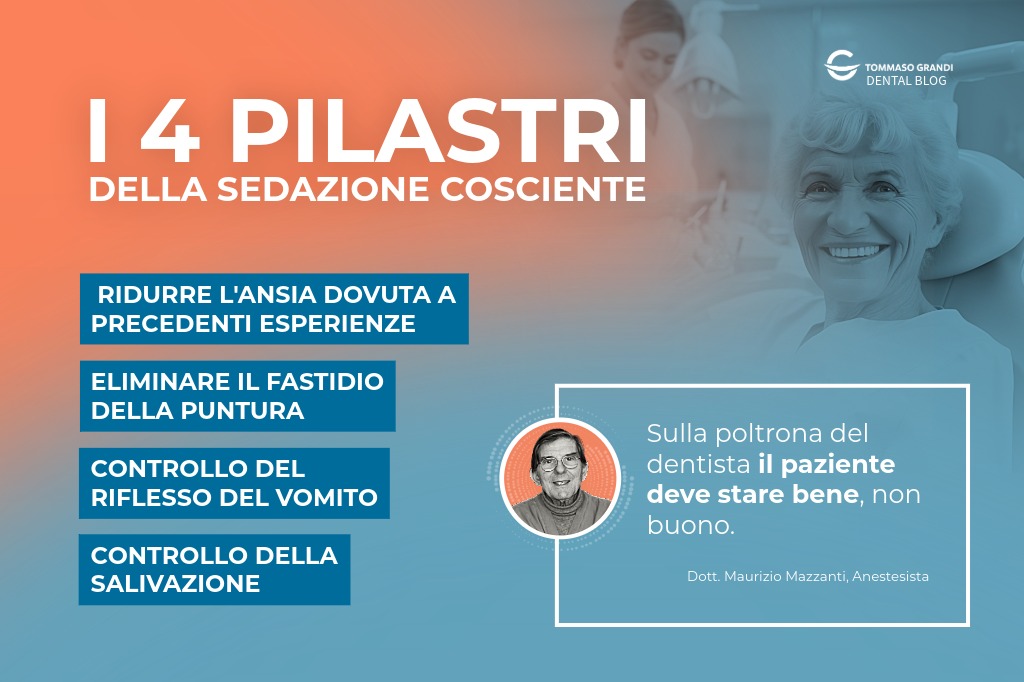
If the thought of going to the dentist makes you nervous, you should know it’s far more common than you think. Often it isn’t “just fear”: it’s memories, discomfort, tension. And when anxiety rises, everything becomes harder. That is exactly the point of conscious sedation: helping you go through treatment calmly.
My motto is that in the dentist’s chair the patient should feel well – not just keep still.
“My motto is that in the dentist’s chair the patient should feel well – not just keep still.” Dr Maurizio Mazzanti, anaesthetist
And he adds a distinction that makes it all clear:
My motto is that in the dentist’s chair the patient should feel well – not just keep still.
In this guide we explain the four “pillars” of conscious sedation: the four most common problems that can be managed to help you feel genuinely at ease in the chair:
- My motto is that in the dentist’s chair the patient should feel well – not just keep still.And he adds a distinction that makes it all clear:”The difference between feeling well and keeping still is that you feel well when nothing is bothering you.”anxiety
- injections and local anaesthesia
- injections and local anaesthesianausea and the gag reflex
- other discomforts (saliva, tension, tiredness)
other discomforts (saliva, tension, tiredness)What conscious sedation is (in simple terms)
Conscious sedation is a medical aid that reduces anxiety and discomfort during treatment.
- It isn’t general anaesthesia: it isn’t “deep sleep”.
- You remain conscious, but much more relaxed.
- The aim isn’t to “disappear”, but to feel at ease.
The four pillars of conscious sedation: what it really manages
The four pillars of conscious sedation: what it really manages1) Anxiety: calming panic before it starts
“The difference between feeling well and keeping still is that you feel well when nothing is bothering you.”
The first thing to manage is almost always anxiety. It often stems from past experiences and “works away” even when you don’t want it to.
“Anxiety is fed by memories of the bad things that happened to you at the dentist in the past.”That’s why the aim is to reduce that inner alarm before it takes over. And this is done quickly and in carefully measured doses:
“These medicines are much more effective when given intravenously in very small doses… they take effect within tens of seconds.”
What it means for you: instead of “holding on” with your heart in your mouth, you can go through the appointment calmly, without panic.
2) Injections and local anaesthesia: less discomfort, less fear
“These medicines are much more effective when given intravenously in very small doses… they take effect within tens of seconds.”2) Injections and local anaesthesia: less discomfort, less fear
Fear of injections is one of the most common. Sometimes it isn’t the needle itself, but the idea of “feeling it” and reliving an unpleasant sensation.Here sedation helps a great deal, because it lowers tension and makes everything more tolerable. Dr Mazzanti also explains a very important practical step:
Fear of injections is one of the most common. Sometimes it isn’t the needle itself, but the idea of “feeling it” and reliving an unpleasant sensation.Here sedation helps a great deal, because it lowers tension and makes everything more tolerable. Dr Mazzanti also explains a very important practical step:”If you give an intravenous painkiller five minutes before the injections, they become much more comfortable.”
In practice: you arrive more relaxed, go through that moment with less stress, and treatment starts on a calmer footing.
“If you give an intravenous painkiller five minutes before the injections, they become much more comfortable.”
3) Nausea and the gag reflex: when your mouth “won’t cooperate”The gag reflex can make even simple things difficult: impressions, work on the molars, wisdom teeth, instruments at the back of the mouth.
“The third thing we’ve been able to greatly reduce is the gag reflex.”
For you this means less retching, fewer interruptions and an appointment that finally feels manageable.
“The third thing we’ve been able to greatly reduce is the gag reflex.”4) Other discomforts: saliva, tension, tiredness, “I can’t do this”
The gag reflex can make even simple things difficult: impressions, work on the molars, wisdom teeth, instruments at the back of the mouth.There are “small” discomforts that, taken together, make an appointment hard going: increased saliva, a constant need to swallow, tension in the jaw and neck, tiredness during long sessions.
There are “small” discomforts that, taken together, make an appointment hard going: increased saliva, a constant need to swallow, tension in the jaw and neck, tiredness during long sessions.Here too there is practical work to be done. Dr Mazzanti mentions it as one of the points to manage:
Here too there is practical work to be done. Dr Mazzanti mentions it as one of the points to manage:When we work in the mouth, saliva increases a great deal… we use a medicine that helps with this too.
“My motto is that in the dentist’s chair the patient should feel well – not just keep still.” Dr Maurizio Mazzanti, anaesthetist
In practice: less discomfort, less stress, and an easier time in the chair.
When we work in the mouth, saliva increases a great deal… we use a medicine that helps with this too.What does conscious sedation feel like?
Patients generally describe:
- Patients generally describe:a “physical” calm, as if the tension is draining away
- fewer negative thoughts
- fewer negative thoughtstime seeming to pass more quickly
- less stiffness
less stiffnessAnd often this is the surprise: they expected to suffer or to “grit their teeth”, but instead they feel at ease. Dr Mazzanti mentions a comment he often hears from patients about feeling comfortable during treatment.
“My motto is that in the dentist’s chair the patient should feel well – not just keep still.” Dr Maurizio Mazzanti, anaesthetistMany patients tell us they felt comfortable and relaxed.
“My motto is that in the dentist’s chair the patient should feel well – not just keep still.” Dr Maurizio Mazzanti, anaesthetist
Is it safe? Who is it recommended for?
Is it safe? Who is it recommended for?Conscious sedation is a well-established practice and, when managed with correct protocols and dedicated professionals, is designed to increase comfort and safety.
It is particularly helpful for:
- patients with strong fear or phobia
- It is particularly helpful for:
- people who have been putting off treatment for years
- people with a strong gag reflex
long or complex procedures (e.g. surgery, implantology)After treatment: what happens?
It depends on the length of the session and how you respond individually, but generally:
- It depends on the length of the session and how you respond individually, but generally:you are given time to recover
- you receive clear instructions on what to do afterwards
- you receive clear instructions on what to do afterwardsit is often advisable to come with someone who can accompany you home
FAQs – questions patients often ask
Conscious sedation is a well-established practice and, when managed with correct protocols and dedicated professionals, is designed to increase comfort and safety.No: its purpose is to reduce anxiety and discomfort. Pain is controlled with local anaesthesia, and with sedation the experience is much calmer.
You may doze off, but that isn’t the aim: the aim is to feel at ease and go through the appointment without stress.
Often, yes – and it’s one of the reasons many patients are finally able to have impressions taken or work done at the back of the mouth without panic.
What types of anaesthesia are used in dentistry today? Read the full guide to find out more
Book a first visit
Would you like to know whether conscious sedation is suitable for you (anxiety, injections, nausea, gag reflex, long procedures)?
Book a first visit at our clinic in Modena: we’ll assess your situation and explain step by step how to approach treatment calmly, with a plan built around you.